
You walk into your home and see the same pile you’ve walked past for three weeks. You know you should deal with it. You want to deal with it. But something stops you every time. That’s not laziness — that’s the psychology of a cluttered home at work. And it runs deeper than you think.

Here’s what most organizing advice gets wrong: it treats clutter like a storage problem. Like, you just need better bins or a better system. But clutter isn’t about the stuff — it’s about what the stuff represents.
Every object in your home is a decision you made. Or more accurately, a decision you put off. That jacket you haven’t worn in two years? It’s not just a jacket. It’s the moment you chose not to decide whether to keep it. The book you never read is the version of yourself you thought you’d become. The kitchen gadget still in its box is money you don’t want to admit you wasted.
Consumer behavior research shows something interesting. The endowment effect means your brain assigns more value to things you own. More than the same things you don’t own. This isn’t logical. And it happens without you thinking about it. The moment something enters your home, your mind makes it seem more valuable than it really is. That’s why you can’t get rid of the bread maker you used once. Your brain has already decided it’s worth more than it actually is.
Then there’s what we call aspirational clutter. These are objects tied to the person you plan to be. The guitar for when you finally learn to play. The juicer for when you start that health kick. The fancy camera for when you take up photography. Each one represents an identity investment. Discarding them feels like giving up on that future version of yourself. So they stay.
The sunk cost mechanism makes it worse. You spent money on these things. And your brain hates admitting waste. So it keeps the object as proof the purchase was justified. Even if you never use it. Even if it just takes up space. The presence of the thing feels better than admitting the money is gone.
This is why decluttering advice that focuses on organization misses the point. You don’t need a better place to put things. You need to understand why you’re keeping them in the first place.
What the Things We Hold Onto Say About Us
Your clutter tells a story. Not about messiness, but about who you are and who you’ve been.
Identity objects are the clearest example. These are things you keep to signal something to yourself. Old trophies from high school. Clothing from when you felt more confident. Books you read during a big moment in your life. They’re not clutter in the normal sense. They’re like external memory storage. They remind you of a version of yourself you don’t want to forget.
Inherited objects carry different weight. When someone dies, their things become stand-ins for the relationship. A parent’s watch. A grandmother’s dishes. A friend’s favorite mug. Your brain treats these objects as extensions of the person. Discarding them feels like discarding the connection. And the guilt of release becomes too much to handle. So the objects stay, even when they serve no real purpose.
Scarcity conditioning explains another pattern you might recognize. People who grew up with money troubles often hold onto things “just in case.” This isn’t hoarding — it’s protective behavior. If you went through genuine scarcity, your brain learned to prepare for it happening again. Keeping extra supplies feels safe. And even when the original scarcity is decades past, the pattern sticks around.
Research on attachment and environment shows something else worth knowing. Familiar objects create a sense of safety. Your brain sees the known world as safe. So some accumulation is your mind trying to build that familiar environment. Without you realizing it. The clutter isn’t random. It’s your mind trying to create comfort through physical objects.
Understanding this changes everything. You’re not failing at organization. You’re dealing with complex emotional ties to your things. That’s harder than sorting things into bins.
Why Organizing Does Not Solve What Accumulation Created
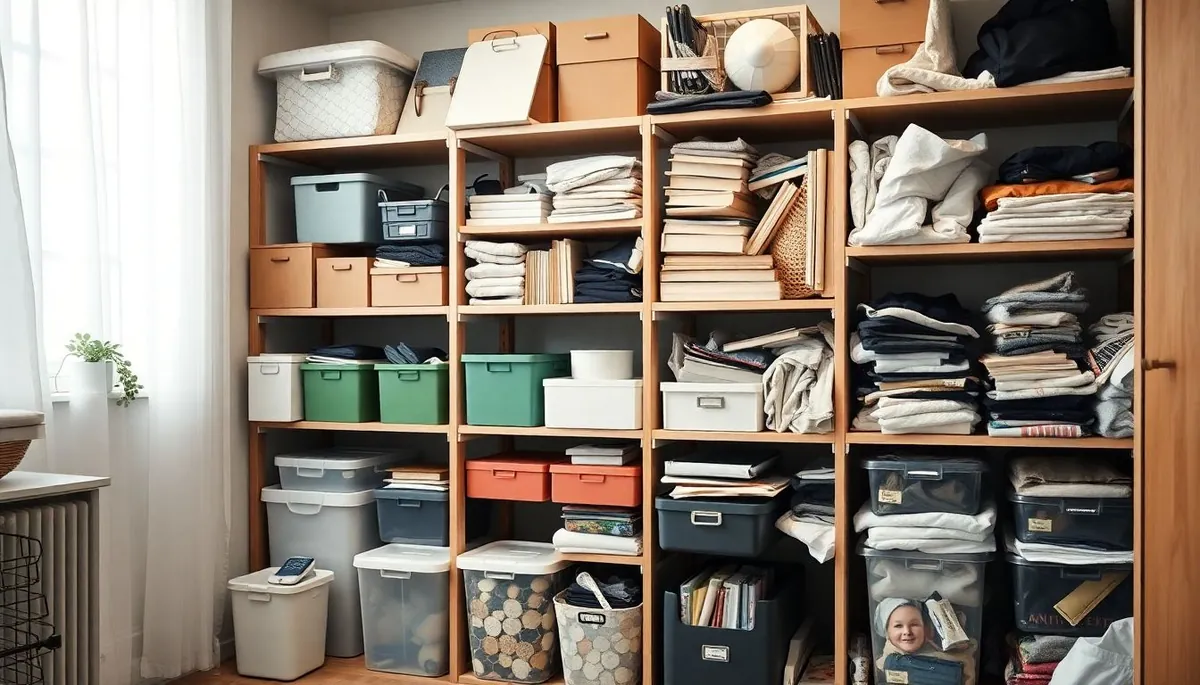
You buy the storage containers. You arrange everything neatly. You label the bins. But three weeks later, it’s a mess again. This isn’t because you did it wrong. It’s because you organized without getting rid of anything.
The reorganization cycle is easy to predict. You tidy up without actually letting anything go. This gives you a neater version of the same problem. All those emotional ties are still there. The put-off decisions are still put off. And the aspirational identity objects are still taking up space. You’ve changed the arrangement but not the relationship.
This is why professional organizers now focus more on decision-making. Not storage solutions. The container is never the real problem. The number of objects compared to your space is. And that number comes down to behavior, not how cleverly you stack things.
Many people can’t get rid of objects without outside permission. Your brain needs a system that makes the decision feel okay. This is why clear rules work better than vague motivation. “Have I used this in the last year?” gives you permission. “Does this serve a current purpose?” creates a decision rule. And “Do I truly value this?” forces honest thinking.
These systems work because they get around the emotional attachment. They give you logical permission to let go.
There’s an important difference here. An organized home and a decluttered home are not the same thing. Organization is about space. You’re arranging what exists. Decluttering is about behavior. You’re asking whether things should exist in your space at all. The first one is easier. But the second one is what actually changes the pattern.
When you’re ready to move from understanding the problem to taking action, how to start decluttering when the volume feels impossible to take on becomes the next question. The diagnosis helps. But so does the action that follows.
The Release and What Comes After It
Something unexpected happens when you start letting go. The relief is bigger than the physical change would suggest.
Research on decluttering keeps finding this same thing. People describe feeling lighter. Clearer. Like they can breathe better. The cleared surface shouldn’t make that much difference. But it does. Releasing objects that no longer serve you has a truly freeing effect. One that goes beyond the practical.
The ability to release things is a skill. And like any skill, it gets better with practice. Start with easy items. Duplicates you don’t need. Expired products. Obvious trash. These simple decisions build your confidence. They train your brain that letting go is safe. That you won’t regret it. And that you’ll be fine without these things.
Then you can move to harder categories. The clothes that don’t fit. The hobby supplies you never use. The gifts you feel you have to keep. Each decision gets easier. Because you’ve shown yourself that release doesn’t equal loss.
For many people, a big declutter feels less like home improvement. And more like personal clarity. The process of deciding what stays shows what actually matters to you. Not what you think should matter. Not what mattered five years ago. But what matters now.
This can be surprisingly helpful. You learn things about yourself through what you choose to keep. Your actual priorities become clear. And the gap between who you are and who you thought you were gets smaller.
What about those aspirational objects? They don’t all have to go. But being honest about them changes everything. This is an aspiration, not a current reality. Some will become active once you admit what they are. And many will leave more easily once you stop pretending they’re part of your actual life.
The doom piles deserve special mention. Those piles of put-off decisions that have grown into something that feels too big to even start. When clutter has built up into something that feels bigger than a clear-out can fix, you’re dealing with a specific mental barrier. The volume creates paralysis. The paralysis creates more volume. And breaking that cycle takes a different approach than standard decluttering advice.
The Pattern Behind the Pattern
Here’s what all of this reveals. The psychology of clutter and disorganization isn’t about being messy. It’s about being human.
You pile up things because your brain is trying to protect you. From waste. From loss. From forgetting. And from becoming someone you don’t want to be. The clutter is proof of your mind doing its job. Just not in a way that helps you anymore.
Understanding this doesn’t make the clutter go away. But it changes how you approach it. You stop treating yourself like you’re failing at something simple. And you start seeing that you’re dealing with something complex. The objects are symptoms. And the real work is addressing what they represent.
This is why quick fixes don’t last. Why organizing systems fail. And why you can clean everything out and have it return within months. You’re treating the symptom while the cause stays the same.
The shift happens when you start asking about your relationship with things. Not just organizing them or getting rid of some. But actually looking at why they’re there and what they’re doing for you. That’s uncomfortable work. It requires honesty about dreams you haven’t chased. Money you’ve wasted. And versions of yourself you’re not ready to let go of.
But it’s also the only work that creates real change.
When you’re ready to address both behavioral patterns and physical reality, a professional home organization that addresses both behavioral and physical needs gives you the structured support that makes the process doable. Because sometimes the insight alone isn’t enough. And sometimes you need someone to work through the decisions with you in real time.
The psychology of a cluttered home isn’t a character flaw. It’s a human response to complex emotional needs. Understanding that is the first step. And addressing it is the second. Both matter.


